

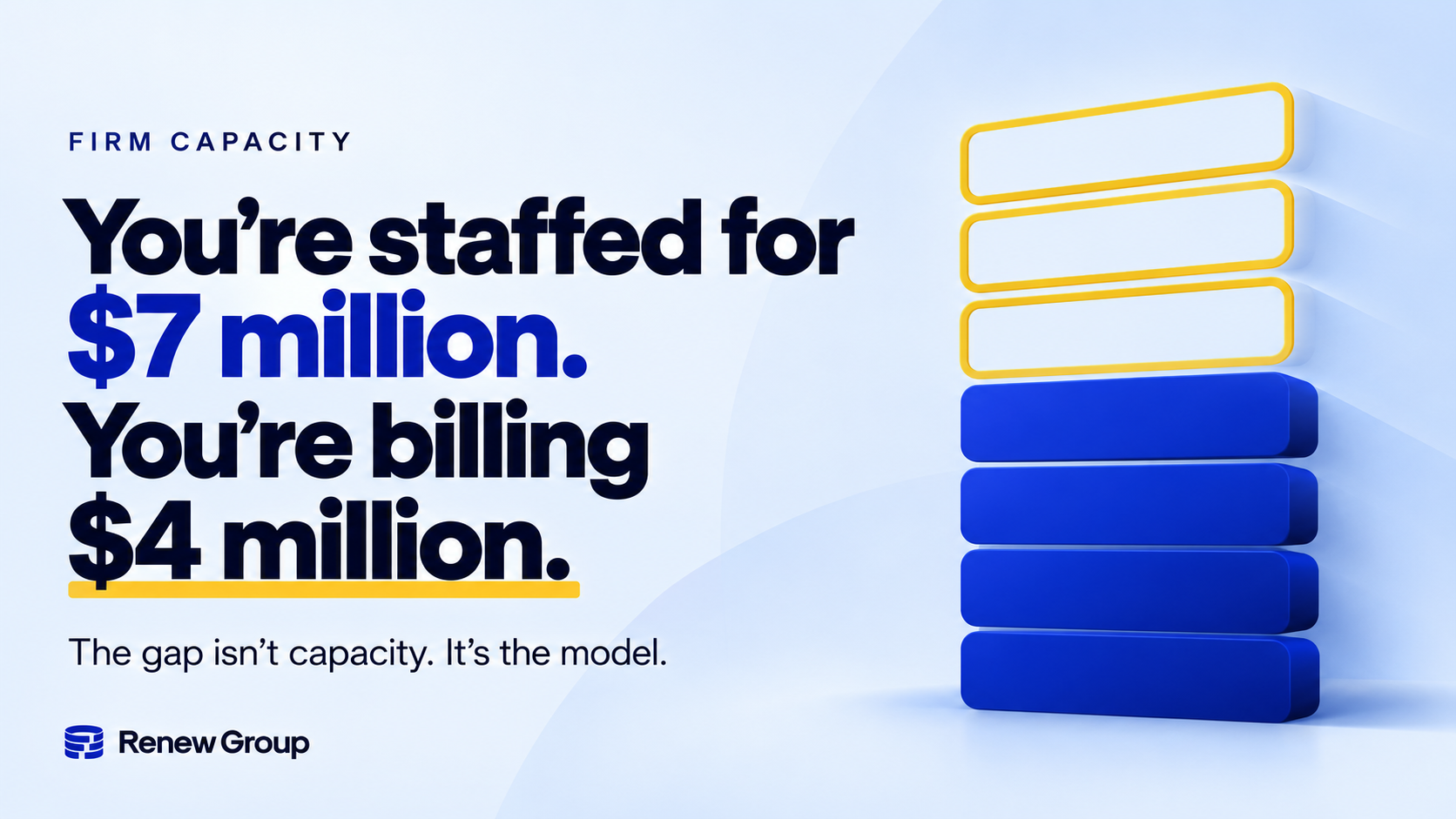

Many firms don’t have a capacity problem. They have a model problem that looks like a capacity problem.
Colin and I recently ran an assessment with the two tax partners at a well-established firm. Around $4 million in revenue, 14 years in, based in a smaller market an hour from the nearest big city. Good people, good clients, nobody in crisis. When we ran the numbers, they had the team to be a $6–7 million firm. They were doing $4 million.
Download the Renew Minimum Price Kit
It’s mediocrity that feels normal. Success was defined as survival, some team bonuses and an underwhelming partner distribution at year-end.
One partner pushed back: "If we've got all this capacity, why would we walk away from revenue?"
Fair question. Nobody wants to jettison clients, keep the same overhead and watch productivity fall further. But those small clients weren't there because they fit the model. They were there to keep people busy.
Two partners, four managers, three or four preparers. "More rectangle than triangle," as one partner put it. Managers cleared review points themselves because it's faster than teaching. Partners waded through stacks of billing that wasn't their time. And the week after Labor Day, days out from a deadline, staff were asking for work.
That's a model issue, and it's why you can't fix pricing in isolation from people and productivity.
Their engagement letters used ranges: $8,000–9,500 for an S corp, a building LLC and the owners' personal return. Not a crazy number, but there are two problems.
Accountants are pricing apologists. Give us a range and we'll bill the bottom of it every time, then write off the rest.
And what's included? The returns and estimates. Planning, meetings and year-end work get billed hourly, later, in arrears. That's where free work lives. It trickles in, doesn't get billed, and rots.
Price upfront, and stop calling it "fixed." Build a year-round package with planning and quarterly check-ins baked in. Make the intangible tangible. Treat it like an insurance pool: price in a few claims so you never nickel-and-dime anyone. That work also happens outside the two six-week bubbles (tax season and fall tax season), which is how you stop being a Deadline-Driven Firm and start filling the capacity that sits idle the rest of the year. Note to self: this model is also where you create value for the right clients (year around) not transactional Insanity Zone clients.
When Colin asked about productivity targets, every client hour on the clock and timesheet reviews, one partner answered: "Yes, yes, yes, and yes."
The harder admission came next. No productivity goals in 14 years. One round of career conversations, two years ago. Bonuses that were generous and based on last year's bonus, plus the fear that people would leave. No centralized management of productivity, career development, pricing or budgeting.
That isn't kindness. Good people want to know what winning looks like, and when nobody tells them, they find a firm that will. As he said himself, it also makes the firm hard to transition internally, let alone sell.
"Survival is success" works right up until it doesn't.
Worried about losing clients? Across all 2026 Renew submissions, the average price increase was 11.5%, and 6.2% of clients left as a result. That isn't lost revenue. That's a better client mix. Do it on those top 130 groups here and this firm clears $4 million from them alone, before anyone sells a thing.
If your firm feels fine but the numbers feel flat, you're probably staffed for a firm you're not running yet.
Download the Renew Minimum Price Kit
Text us at 317.496.2192
if you want to talk it through.
